
A bone graft for dental implants becomes necessary when your jaw lacks enough bone to hold an implant securely. Not every patient who wants an implant can get one right away. The reason is often invisible until a dentist takes a close look.
Bone loss happens quietly, often over months or years, long before any physical sign appears. This guide explains what causes that bone loss. It also covers which grafting procedures rebuild the missing volume. You’ll also see what the process looks like from surgery through a finished implant.
Key Takeaways
- Tooth loss and gum disease can shrink the jaw enough to stop a dental implant from taking hold.
- Onlay bone grafts add volume on top of the jaw ridge, one of several procedures used depending on the defect.
- Dentists complete grafting under local anesthesia, and the jaw needs several months to rebuild before implant placement.
- Knowing your bone condition before treatment is what separates a plan that works from one that fails.
- Get answers to the most common questions patients have about bone grafts and dental implants.
Why Bone Loss After Tooth Loss Makes Dental Implants More Complicated
Bone loss in the jaw starts as soon as a tooth root is gone. A systematic review in the Journal of Oral & Maxillofacial Research found that this process begins quickly and continues for years. The root did more than hold the tooth in place. It pressed against the bone with every bite, and that pressure signaled the bone to stay strong. Without that stimulation, the body treats the area as unnecessary and starts breaking it down.
This process moves faster than most people expect. In the first year after a tooth is lost, the ridge can lose noticeable width and height. Patients rarely notice this because the change happens beneath the gum line.
Periodontal disease causes similar damage, but from a different direction entirely. Gum disease breaks down the tissue and bone that hold teeth in their sockets. The CDC reports that periodontitis affects about 4 in 10 U.S. adults. Many patients arrive at an implant consultation with a jaw already reshaped by long-term infection.
Dental injuries are a third common cause of bone loss. A tooth knocked out or removed after trauma can leave a socket where the bone walls have collapsed inward. Titanium implants need a minimum bone width and height to function as stable tooth replacements.
The physical sign of long-term bone loss often shows up in the face. Without bone to fill out the jaw, the lower face can look sunken. This facial sagging signals that bone loss has passed the point where a standard implant fits without preparation.
How CBCT Scanning Reveals Hidden Bone Deficiency
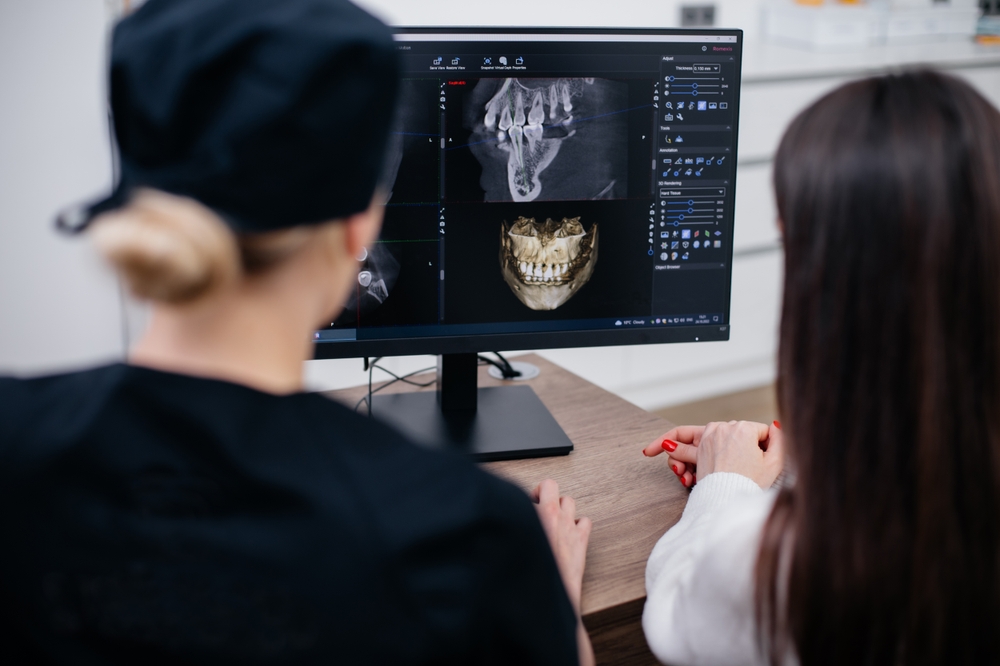
CBCT scanning produces a three-dimensional image of the jaw. That third dimension is what makes it valuable for implant planning. A standard X-ray only shows how tall the bone is. It cannot show how wide the ridge is or whether the interior is dense enough to hold a screw. A 3D scan captures both measurements in a single pass.
The results tell the dental team whether grafting is needed and which graft type fits the defect. They also show how much volume must be rebuilt before the team can move forward with implant placement. Planning without this data means working from an incomplete picture. Bone grafting addresses this gap directly once the scan confirms what is missing.
Onlay Bone Grafts and Other Bone Augmentation Procedures Explained
An onlay bone graft sits on top of the existing jaw ridge, not inside it. Research in Medicina Oral, Patología Oral y Cirugía Bucal shows onlay-grafted implants perform similar to implants placed in native bone. When the ridge has shrunk too much, a standard implant sits above the bone rather than in it. An onlay graft adds the missing height or width.
The graft attaches to the existing bone surface and stays fixed in place. The body fuses the two over several months. This bond eventually gives an implant post enough structure to handle normal chewing forces.
The source of the graft material shapes how the procedure unfolds. Autogenous bone grafts use bone from the patient’s own body. Intra-oral grafts take bone from inside the mouth, often from the chin or back of the jaw. These sites tend to heal predictably.
When a defect is too large for an intra-oral source, iliac crest grafts draw material from the hip instead. Iliac bone grafting provides more volume for larger areas of bone loss. A 2025 study in Bioinformation reported that implants placed in grafted sites achieved a 95.5% survival rate.
Socket Preservation and Sinus Lift: When Are They Used Instead?
Socket preservation happens right at extraction, not months later. Grafting material goes directly into the empty socket before the surrounding tissue closes over it. The goal is to maintain the ridge shape during healing so the bone is still available when implant planning begins.
A sinus lift addresses a different problem specific to the upper jaw. The sinus cavity sits just above the back teeth. Once those teeth are lost, the sinus can drop into the space the roots once occupied. Adding bone beneath the sinus floor restores the height an implant needs.
Ridge augmentation covers cases where the jaw has become too flat or narrow for implants, regardless of location.
Alveolar Ridge Augmentation and Guided Bone Regeneration
Alveolar ridge augmentation rebuilds the jaw ridge when bone loss has reduced its height, width, or both. The procedure may use autogenous bone, a synthetic substitute, or a combination, depending on the volume needed.
Guided bone regeneration adds a protective membrane over the graft site during healing. The membrane keeps faster-growing soft tissue from crowding into the space before new bone can form. This technique works well for smaller defects and often pairs with onlay procedures.
Distraction osteogenesis handles more severe cases. Surgeons slowly separate a bone segment over several weeks, and new bone gradually fills the widening gap. It is less common, but it can generate volume that graft material alone cannot match.
For patients with severe upper jaw bone loss, a sinus lift may not be enough. Zygomatic dental implants can anchor into the cheekbone instead of the jaw. Patients asking about full-arch tooth replacement may also want to know about All-on-4 Dental Implants. All-on-4 uses angled rear implants to work around bone deficiency.
What to Expect: Oral Surgery, Healing Process, and Long-Term Stability
Most patients receive bone graft oral surgery under local anesthetic. Research published in PubMed Central indicates that full osseointegration typically requires 4 to 9 months of healing. The injection numbs the area while the patient stays awake and comfortable.
Dentists use general anesthetic in select cases for extensive procedures. This depends on case complexity and the patient’s overall health history. For larger procedures involving multiple graft sites, a dental professional may recommend additional sedation.
The surgical team opens the tissue over the graft site and shapes the area to receive the material. A protective membrane often covers the graft before the tissue closes. Most patients go home the same day.
Post-operative care in the first week focuses on keeping the site clean and avoiding anything that could disturb the graft. Some soreness is expected, and swelling typically peaks within the first two to three days. Over-the-counter pain relief is usually enough for most patients.
Recovery before implant placement takes longer than most patients expect. The jaw needs time to replace graft material with mature bone strong enough to carry an implant post. Soft tissue heals faster than bone, so the site can look normal on the outside before the underlying bone finishes healing.
Surgeons sometimes add platelet-rich plasma to the graft site to support healing. It delivers concentrated growth factors to the site. Some oral surgeons use it to shorten the timeline.
Peri-Implant Bone Loss: The Long-Term Risk Worth Knowing
Once osseointegrated fixtures are in place and in daily use, a different kind of bone loss can develop. Peri-implant bone loss happens when bacteria build up around the implant base and trigger inflammation.
Long-term stability depends on what happens after placement, not only on how well the graft worked. Patients who keep up with cleanings and treat gum disease early tend to have better implant survival. Following post-operative instructions also helps.
Guided surgery and precise implant positioning reduce stress on the bone-implant interface. Implant success is an ongoing condition, not a one-time result.
Why a Bone Graft for Dental Implants Changes Your Odds
Choosing the right bone graft for dental implants can determine whether your implant lasts for decades. Bone loss from tooth loss, gum disease, or injury does not repair itself. Skipping this step raises the risk of implant failure.
Patients who address bone loss before implant placement typically see stronger long-term results and fewer complications. The right procedure depends on your anatomy, the extent of the loss, and where the deficiency sits in your jaw. If you’re wondering whether your jaw is ready for an implant, schedule a bone graft consultation and get a clear answer backed by imaging, not guesswork.
FAQs
What is bone grafting for dental implants?
Bone grafting for dental implants rebuilds jaw volume so an implant post has enough bone to anchor securely. It replaces bone lost to tooth loss, gum disease, or trauma using material from your own body, a donor source, or a synthetic substitute suited to your case.
How is bone grafting done for dental implants?
Your dentist numbs the area with local anesthetic, then opens the gum tissue to access the jawbone. The dentist places graft material against the bone, sometimes covers it with a protective membrane, and closes the tissue. Most procedures take under an hour, and patients typically go home the same day.
How much does bone grafting cost for dental implants?
Cost varies widely based on graft material, defect size, and whether sedation is used. Minor grafts cost less than larger procedures, such as sinus lifts or iliac crest grafting. Many practices offer financing plans, and some dental insurance covers part of the cost. Our dental team can provide a personalized estimate during your consultation.
Is bone graft safe for dental implants?
Bone grafting is a well-established procedure with a strong safety record when a qualified dental professional performs it. Complications like infection or graft failure are uncommon and often linked to smoking or unmanaged health conditions. Following post-operative instructions closely and attending follow-up visits significantly lowers your risk of problems.
Do you need a bone graft for dental implants?
Not every implant patient needs a bone graft. A bone graft is only necessary when imaging shows insufficient bone width, height, or density to support an implant post. Patients with healthy, adequate jawbone can often move straight to implant placement. Our dentist determines this need through a CBCT scan beforehand.